


Accessing Your Inner Creator:
The Way of Beginning (continued)
©1996 by Carlisle Bergquist, LCMFT, Ph.D.c.

Christian mystics stress the importance of keeping to the straight and narrow path, the center between the polarities of heaven and earth.
In A Treatise on White Magic, Alice Bailey teaches:
"Let the magician [creator], guard himself from drowning at the point where land and water meet. The midway spot, which is neither dry nor wet, must provide the standing place....there is the place for magic to be wrought."
An important word of caution: the duality of yin/yang and its myriad derivatives in form is not, repeat is not, the same as the duality of good and evil. Good and evil are both served by entraining with the power found upon the middle path: they both unify the natural duality yin/yang in the act of creation. It is the intention of the adept creator that separates good from evil. One fosters evolution toward harmonic unity, while the other brings quick personal reward, stagnation and separation.
Gopi Krishna speaks of the awakening of the Kundalini force that lies sleeping in human kind. He believes it is synonymous with creativity. It is a path of re-creation that again involves the "bisociation" of opposites, Shakti and Shiva. He urges aspirants to cling to the middle path and avoid the extremes they will meet. If an aspirant directs the Kundalini upward, it is an evolutionary force that brings union with the Divine. If the aspirant loses the balance on the middle way, the Kundalini force can turn downward bringing destruction, separation, and madness.
Inward and outward, balancing opposites is the rhythm of mystic teachings and the creative process; for creating, on every level of being, is a transpersonal act: it is the domain of spirit, a land of magic that demands respect. With care we develop vision to find the way between these polarities and participate in the act of creation.
Harnessing this creative force requires that we see more fully despite our limited human perspective. We pursue such vision in a creative act through what St. Bonaventure describes as: "the eye of the flesh, the eye of reason, and the eye of contemplation." We must learn through which "eye" we perceive a given type of reality, and in which realm a specific creative task lies. Thus, to be a creator is to perceive knowledge with these three"eyes," give it meaning in the world, and bring it to form.
Such knowledge applies to discrete realms of experience and of the creative process. Failure to discriminate between the perceptions of these different "eyes" results in what Ken Wilber calls "category error." It renders creation impotent, if not destructive, and often fragments, blocks, or limits the creative processes of our species. I will briefly describe these three ways of knowing and relate them to the act of creation.
- The "eye of the flesh" gathers empirical knowledge. We learn and verify it through the physical senses, or instruments that extend them.
- The "eye of reason" is interpretive. It symbolizes, organizes, and interprets ideas, impressions, and feelings. St. Bonaventure said this realm deals with the "threefold activity of the soul"; that is, the psychic functions of memory, reason, and will.
- The "eye of contemplation" beholds transcendent realms in the experience of gnosis. It is the instrument of inspiration. In gnosis, one unites with the transcendent realm of inspiration and illumination.
Religious traditions allude to transcendent states but debate their names and descriptions perhaps because of our inability to convey ecstatic experiences adequately through language: we only reduce them.
Ken Wilber explains how reduction takes place when information transfers from a more complex, to a less complex dimension:
"Whenever higher dimensions are represented on lower ones they necessarily lose something in the translation...whenever a three-dimensional sphere is reduced on a two-dimensional surface it becomes a circle."
The next logical reduction is that the circle represented on a one-dimensional media appears as only a straight line. "Higher" transcendent dimensions (inspirational experiences), are similarly reduced, and abstracted through reason and empirical application. It is often diminished to dogma.
The skill needed by a creator is to capture inspirational experience in its purest form and transmute it so the eyes of reason, and of the flesh, perceive it. Creation myths are products of Gnosis so transmuted to the "lesser" dimensions of reason and the empirical flesh: they suffer from their reduction.
The three "eyes" described by St. Bonaventure have very practical application for a creator when combined in a rhythmic manner. They offer you access to your inner creator. I call this process Rhythmic Imaging.
- First use the eye of the flesh to prepare your creative task using all the attractive determination you have.
- When you can no longer prepare, incubate your creative task by forming a mental symbol of it in your mind's eye, the eye of reason. This impregnates your deep subconscious mind by actively sending this image inward. You may find the contemplative state is more easily achieved using a repetitive rhythmic event, for example, watching the waves, or the wind blowing in the trees.
- Let your image disappear repeatedly into the chosen rhythm. Then open your attention, for after some time the eye of contemplation will return the symbol reformed.
- This symbol holds the birth of your creation, interpret it again with the eye of reason.
- Finally, bring your creation into form through active physical effort.
"Imagine a great number of tiny bells hanging near each other.If some of these are struck sharply, they will transmit their own resonance throughout the ensemble. No bell will remain the same, thus creating a new state for the whole of them".- The Universe Is A Green Dragon, Brian Swimme.
Like these tiny bells that are each responsive to the whole, humankind is inextricably embedded in a universe of creativity: our independence is an illusion. Creators serve as a vehicle through which information transfers from the infinite to humankind. In creators, the first overtone of resonance appears: humankind, like the rest of the universe, resonates in response, or be shaken from existence. Like the bells, when one creator "chimes", a new state exists in us all.
The laws of physics explain the transfer of resonance between the bells, but the information transfer in great creative works transcends physical law: it is transpersonal. That is, it transcends individual personality and includes the interaction of spirit. There are many examples of great artistic and scientific work that are remarkably similar, though their authors have had no exposure to one another. It as if both creators perceive the same information through the eye of contemplation and transmute it independently into physical form.
Transpersonal creations go beyond physical, emotional and mental information exchange to touch and alter our collective consciousness. We know them deeply and a new consciousness emerges in the whole. Through them we entrain with one another and perform "as if" one: through them we touch our common spirit.
Not all creators achieve this transcendent state nor transmute it in their work, but when successful the transpersonal transfer includes the receiver. The experience unites and changes both the creator and his/her patrons. Through this vehicle in its highest form, creators inspire and evolve humanity.
Creativity is a universal process in which we participate. I have attempted to synthesize diverse examples in this writing to reveal a common pulse: the creative pulse upon which the myriad forms cavort. The pulse portends omnipresence; and entraining with this rhythm, as we are able, may reveal a deeper understanding of creativity.
William S. Condon discovered that muscles in separate individuals entrain in micromotions as they communicate with each other. We learn it as infants staring into our mother's face. We must entrain in this way to understand each other in conversations. Failure to do so causes miscommunication, conflict, or isolation.
How much more perilous is it to be "out of sync"with the beat of creation? Like bells, we are "a chord" resonating in a universe of vibration.
Tung Chung-Shu said of harmonic entrainment twenty centuries ago:
"A beautiful thing calls forth things that are beautiful . . . an ugly thing . . . things that are ugly . . . for things of the same kind arise in response to each other."
By learning to entrain, or "tune into," the larger creative pulse, we increase our individual creative expression. Taoists call this finding one's Te, one's unique, individual expression of the Tao. A universe of rhythm is lacking without your unique harmonious beat.
In The Silent Pulse, George Leonard expresses:
"At the heart of each of us, whatever our imperfections, there exists a silent pulse of perfect rhythm, a complex of waveforms and resonance, which is absolutely individual and unique, and yet which connects us to everything in the universe. The act of getting in touch with this pulse can transform our personal experience and in some way alter the world around us."
Participating in the dance of Shakti and Shiva, the dance of creation, requires perception with the three "eyes" St. Bonaventure described.
- The "eye of the flesh" makes preparation in the empirical world.
- The "eye of reason" separates "the wheat from the chaff" and provides entrance to the receptive womb that sustains the embryonic creation.
- The "eye of contemplation" perceives illumination and births the ripened creation.
- The "eye of reason" then becomes the birth canal transmuting illumination back to the empirical world.
- Finally, the "eye of the flesh" verifies the creation in the world of the senses.
 |
THE CYCLE OF CREATIVE CONSCIOUSNESS
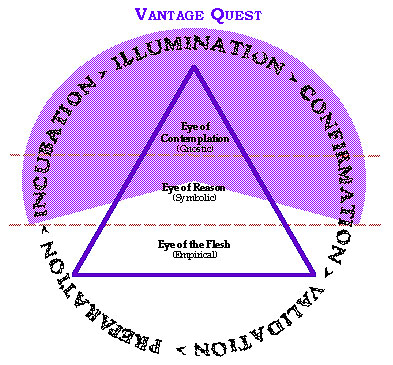
- It begins with a broad base in the physical world, the Preparation stage.
- We then form symbols in our mental reasoning; this is Incubation.
- The Illumination (or Inspiration) stage occurs when we surpass reasoning and allow ourselves to merge with the unknown in contemplation.
- This creative inspiration is then converted back into symbols that we verify internally in the Confirmation stage.
- Finally, the creative product is formed in the world of the senses and validated by its usefulness -- the Validation stage.
The creative process cycles through St. Bonaventure's three realms of consciousness, as illustrated in the triangle above. There are various stages, as illustrated on the circumference of the circle. I have adapted Wallas' four-stage model mentioned earlier by expanding the verification stage. Confirmation is the internal process of verification that uses the eye of reason. Validation occurs in the external world and is the empirical verification provided by the world around us. Thus in The Cycle of Creative Consciousness, creation takes place as the individual's consciousness rises toward the apex of the triangle and then returns again to the empirical world in the cycle shown circumnavigating the triangle. The successful translation from one "eye" to the next is the key to creativity. (The Vantage Quest process described elsewhere in this site accelerates the entrance into reverie, thus allowing access to the contemplative state in which symbols are transformed.)
A Course In Miracles describes our place in the creative process with spiritual eloquence as follows:
"Creation is the sum of all God's thoughts, in number infinite, and everywhere without all limits . . . God's thoughts are given all the power that their own Creator has. For He would add to Love by its extension. Thus His Son [creation] shares in creation, and must therefore share in the power to create (Anonymous, 1976).
In conclusion, I seek to empower you, the reader, with a new view of the creative process. Through this new view, I hope you discover your own creative rhythm and sound your own unique chord in a vibrant universal symphony.
As a creator, you do not create in a vacuum. Your work, like a stone cast upon the tiny bells, resonates far beyond your view. A painting may inspire a song, a song may inspire a book, a book may inspire a movement or simply a smile to someone who needs it and that smile may inspire a song.
No matter what your work, you initiate a new state in us all.
- Re-create the world in your work as if the world depends on it.
- Re-create the world in your work to conform with your highest vision.
- Re-create the world in your work as if it matters.
After all, the universal symphony infinitely begins its play, and your inner creator already knows the dance.
©1996 by Carlisle Bergquist. All rights reserved.
______________________________________________________
CARLISLE BERGQUIST, Ph.D.c.., M.F.C.C., is a psychotherapist and creative theorist with a background as a creative and performing artist. Carlisle's current book - "The Coyote Oak: Burgeoning Wisdom" is available here, at Amazon.com, and booksellers worldwide. He is also the developer of Vantage Quest, a revolutionary new personal creativity tool on compact disk, that is available on this site. He also offers individual work, workshops, and seminars on creativity and spirituality, independently, or through sponsoring organizations. You may contact Carlisle directly for workshops and materials.
.
Article Summaries
The Coyoté Oak: Burgeoning Wisdom
(Preview Chapters)
by Carlisle Bergquist ©2007
A modern-day parable for planet in transformation.
"The Coyoté Oak: Burgeoning Wisdom by Carlisle Bergquist lives up to its name. Like the trickster Coyoté, this fanciful read informs with unpredictable authority. The visionary novel weaves deep ecology, shamanism, quantum physics, Native American spirituality, Taoism, mysticism, and even Christianity into an engaging healing adventure. No small accomplishment as its wisdom rings loud and exquisitely clear. The author’s vivid descriptions engulf the senses; you can almost taste the pancakes, smell the moss, see the sunsets and you will certainly fall in love with the characters. Expect to be drawn in deep, transformed and left howling for more." Share Guide - San Francisco, CA
Available wherever books are sold
ISBN: 0-9791750-6-2
Published by
Reality Press
An Exploration Using General Living Systems Theory
Creativity is the merger of matter/energy with new information. The process of bringing something new into existence, is an inherent characteristic of life. To live is to create whether we do so unconsciously, or with full awareness. This essay is an academic approach to the creative process using James Miller's General Living Systems Theory to model the course from non-being to created work.
Psychoanalytic, Behaviorist, & Humanistic
Three streams of thought in contemporary psychology view our humanness is distinctly different ways. This is nowhere more evident than in their efforts to explain creativity. This essay explores and compares these divergent views and provides a foundation from which to develop a new transpersonal theory of creativity.
A Theory of Creative Entrainment
The holistic theory models entrainment as a communicative occurrence. Examples are given from several disciplines and four stages of entrainment are delimited. The essay compares theoretical quantum physicist David Bohm's notions of order with the realms of spirit, mind, and body. It proposes stages of entrainment operant throughout these realms and suggests that they perform cumulatively in the creative or unfolding process. The systems perspective develops the thesis that humankind is an iteration of a larger system and that entrainment is a central factor in the transduction of information between individuals and across system levels.
An Exploration of Resonant Being
Many cultures around the globe embrace sound in their exoteric and esoteric traditions. This essay reviews the role sound plays in the religions, creation myths, and sacred technologies of various peoples. This review connects creativity with healing which is considered an act of regeneration thus creating health in the body. Several varieties of healing through sound are discussed including music, drumming, toning, chant, instruments, Kabballah, and prayer. The essay proposes that techniques of sound healing and therapy currently rely on the intuitive ability of individual practitioners. Acknowledging the need for effective healing modalities, it calls for research that can qualify the elemental effects of existing sounds, tones and prayers. Such categorization may help construct an applied holistic healing technology.
Nutrition for Colossal Creativity & Peak Performance
Colossal creativity is a state of balance amongst the mind, the body, and the spirit that actuates human potential. This article concentrates on the vitamin and nutritional components of our system so that they resonate more clearly. The focus is on the brain which rests at the focal point of our physical, mental, and spiritual worlds. It traps and interprets inspiration that comes from deep within, transforming it from one world to another. Colossal creativity unfolds when we nourish every part of our being. Digest new thoughts and ideas to nourish your mind. Develop a daily practice -- whatever your faith -- that invites active participation from your Spiritual-Self.
An essay for general audiences that explores the creative process comparing it with the duality described in many philosophical and spiritual traditions. Techniques are given to apply these strategies to ones individual work.
An academic, yet deeply personal essay about exceptional encounters in Brazil with alternative healing and spiritual tradition. It details a dynamical systems (chaos theory) model of creativity: at "The Valley of The Dawn" a spiritual healing community; in Amyr, a physical medium; and in my experience using Ayahuasca with "The Santo Daime Doctrine" in Rio de Janeiro.
by Paul Krumm
Toward an Economy Based on Curiosity and Caring Instead of Greed
by Paul Krumm
Abstract:
- While the network of money transactions around the world is very complex, the way money works is really rather simple, and is understandable by the ordinary person.
- The study of the operation of money is pivotal to any discussion of cultural values and social justice, as money is the basic language of economic relationships, and the values built into this language impact all social relationships.
In this paper we will describe how the present money game is structured. We will show that the idea that money is value neutral is not correct, and go on to describe how money functions to promote greed.
Some preliminary suggestions will be given, based on theory and what has worked in the past, to change the values built into our money to ones that are more congruent with a curiosity and caring driven economy.
We will also show how the present money game is not sustainable, note that the same changes that lead to a curiosity and caring based system are the same changes that make money and our economy sustainable.
Transforming Reality Through The Arts
by Coni Ciongoli-Koepfinger
Could this be the key to CREATIVE EVOLUTION? Is the creation of a society that questions the reality of its fiction and the fiction of its reality be but a page turn away. Conceivably it is no longer a question of controlling what is real; instead, is it a question of controlling the market analysis that controls what the individual assumes to be real? Perhaps then, we will able to give birth to the new science that is no longer bipolar in its relations of the art and the social – a new science that is born out of a culture that was modified to be the perfect blend of both fact and fiction.
Staying
Centered in Peace
by Lisa Hepner
An essay written in the wake of events on September 11, 2001. This piece addresses the struggles we experience to see beyond the pain. The author draws together the thoughts of many personal growth writers into an inspiring tonic for our wounded souls.